Drywood termite spot treatment fits isolated infestations where colony activity remains confined to identifiable architectural members. Historic 1920s bungalows in Kenwood and Old Northeast often present isolated…
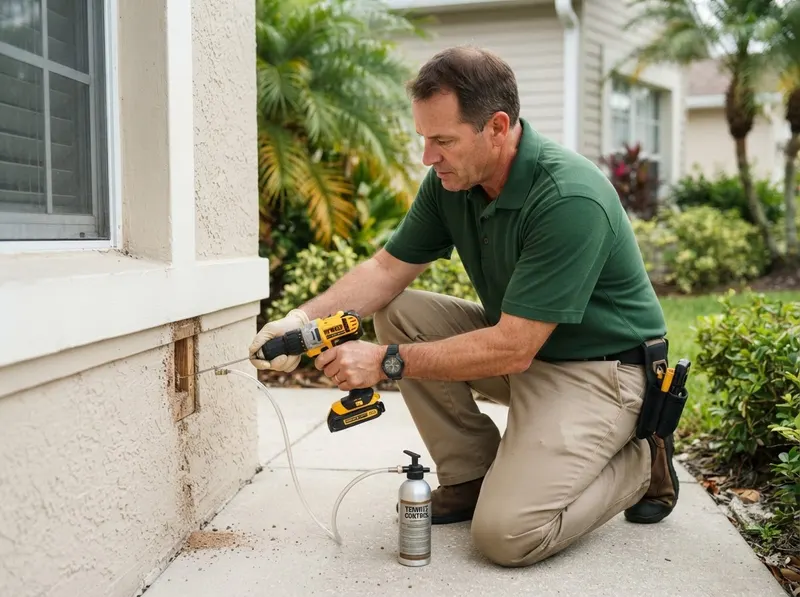
Drywood termite spot treatment fits isolated infestations where colony activity remains confined to identifiable architectural members. Historic 1920s bungalows in Kenwood and Old Northeast often present isolated activity in tongue-and-groove pine or original hardwood floors, while waterfront homes in Snell Isle and Shore Acres frequently show evidence along exterior fascia subjected to coastal winds. When kick-out holes deposit hexagonal fecal pellets (frass) under a single window frame or along an attic truss, localized treatment penetrates the occupied galleries without displacing residents or exposing coastal waterways like Tampa Bay to broad chemical runoff. The operational trade-off centers on spatial scope: spot treatment addresses confirmed, accessible galleries directly, avoiding the extensive prep and chemical loads of structural tenting, but it does not treat completely hidden or inaccessible lumber buried behind finished masonry.
Technicians identify active galleries using structural acoustic assessment and visual mapping of emergence pinholes. The treatment protocol involves drilling deliberate 1/8-inch access points directly into the infested timber conduits, followed by low-pressure mechanical injection of specialized non-repellent agents or localized borate-based wood preservatives. This method prevents indoor airborne dispersion, ensuring treatments remain gentle on household pets while eliminating the colony through natural contact transfer within the wood matrix. Surrounding neighborhoods like Euclid-St. Paul's and Crescent Lake, dense with mature laurel oaks and high summer humidity, experience high seasonal swarm pressure from May through August, making targeted early interventions effective at preventing structural framing degradation before colonies bridge into load-bearing supports.
Properties in Disston Heights and Coquina Key exhibiting widespread, multi-story structural infestation across inaccessible wall voids require a broader whole-structure remediation protocol rather than targeted intervention. Spot treatment serves homes where frass emergence is isolated to three linear feet or fewer of exposed lumber, door frames, or roof decking near soffits. Diagnostic appointments confirm gallery boundaries on-site to verify whether targeted injection provides complete control, avoiding unnecessary broad-spectrum applications across unaffected living spaces.
Every job gets a firm, written price after a free on-site visit.
Tell us about your drywood termite spot treatment job in St. Petersburg and we'll send a clear, written quote, usually the same day.
 Pelican Grove Pest Control